
The day is over. Your mind keeps going.
You have closed your laptop and may already be sitting on the sofa. Yet a conversation is still on your mind. Then there is the shopping list, and a task waiting for you tomorrow.
Having to “meditate properly” can feel like another demand. But you can begin with exactly this busy mind. In meditation, you practise gently bringing your attention back. Perhaps to a voice, the contact with the floor or your natural breath.
Your attention wandering is part of it. You notice, and you return. That simple moment can be a beginning, even when things inside still feel unsettled.
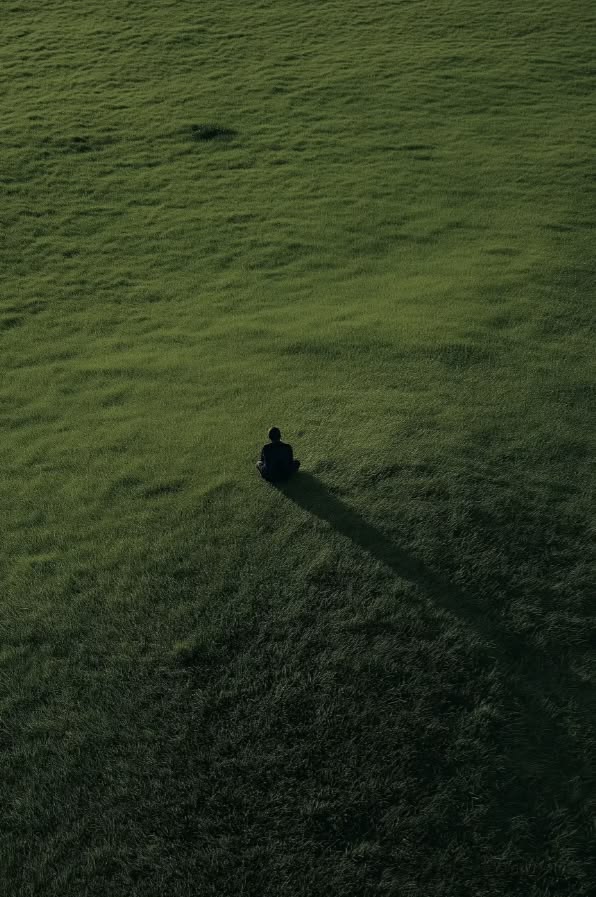
Can meditation help with stress?
A review of 17 studies published in February 2026 examined mindfulness-based programmes for adults without a clinical diagnosis. After the programmes, participants reported less stress on average than the comparison groups. [1]
The research supports making regular mindfulness practice part of everyday life. It cannot predict how each individual meditation will feel for you. The programmes studied took place over time and varied in their design.
You can begin before your mind becomes quiet.

What can be measured in the body
Alongside people’s experience of stress, researchers are interested in changes in physical measures. A meta-analysis from September 2026 found lower average cortisol levels following MBSR programmes than in comparison groups. MBSR stands for Mindfulness-Based Stress Reduction, a structured mindfulness programme lasting several weeks. Results varied considerably between studies. [2]
Cortisol performs important functions in the body, so a lower level is not automatically better. Findings from a programme lasting several weeks cannot be transferred to a single sound meditation. They help put the research in context without expecting a particular result from one session.

How a regular practice can fit into your day
In a large employee study, the commitment was manageable: ten minutes of digitally guided meditation each day for eight weeks. Afterwards, the meditation group reported less stress than the waiting-list group. The study did not establish whether the programme was better than other forms of relaxation. [3]
What interests me most is the regular place it had in everyday life. Choose a time you look forward to returning to and that feels realistic for you. Perhaps in the morning before looking at your phone, or in the evening when you arrive home. Five minutes can be a personal starting point; that is a suggestion, not a prescription derived from the study.
For ways to make room for recovery together, read A culture of taking breaks starts with leadership.

How you can explore meditation with me
You arrive and find a comfortable place. I explain the flow and guide you through the meditation with my voice. When crystal singing bowls are part of the session, you hear them played live in the room and can listen to their sound fading away.
There is no particular feeling you have to achieve. You can keep your eyes open, change position or leave out an exercise. Tell me what you need to feel comfortable with the setting.
My free five-minute meditation offers a first impression. If you would like to share an hour in person, Sunday Sound takes place at ART Galerie Hibler in Vaterstetten. A mat, cushion and blanket are ready for you.
Read about bringing meditation and sound together in When sound changes your attention.
Further reading
Sources for this article
- Rajan, Kumar & Raj P (2026): Effects of mindfulness-based interventions on perceived stress among non-clinical adults. npj Mental Health Research, 3 February 2026. 17 RCTs; 1,641 participants. Between-group difference: SMD −0.53 (95% CI −0.72 to −0.33).
- Johnson et al. (2026): Mindfulness-based stress reduction interventions and cortisol regulation: A systematic review and meta-analysis. Health Psychology, online 3 September 2026. 39 studies; 2,059 participants. Differences between studies limit general conclusions.
- Radin et al. (2025): Digital Meditation to Target Employee Stress: A Randomized Clinical Trial. JAMA Network Open, 14 January 2025. 1,458 employees; eight weeks; comparison with a waiting list.
Editorial and research information as of 28 October 2026. A selection of relevant academic publications, not a complete systematic review. The studies investigate different programmes and groups of people; they do not demonstrate the effectiveness of my own sessions.