When silence feels difficult
You lie down, and suddenly everything that had no space during the day comes to mind. A conversation, a worry, tomorrow’s list. A sound can give you something to listen to: its beginning, its resonance and the moment it gradually disappears.
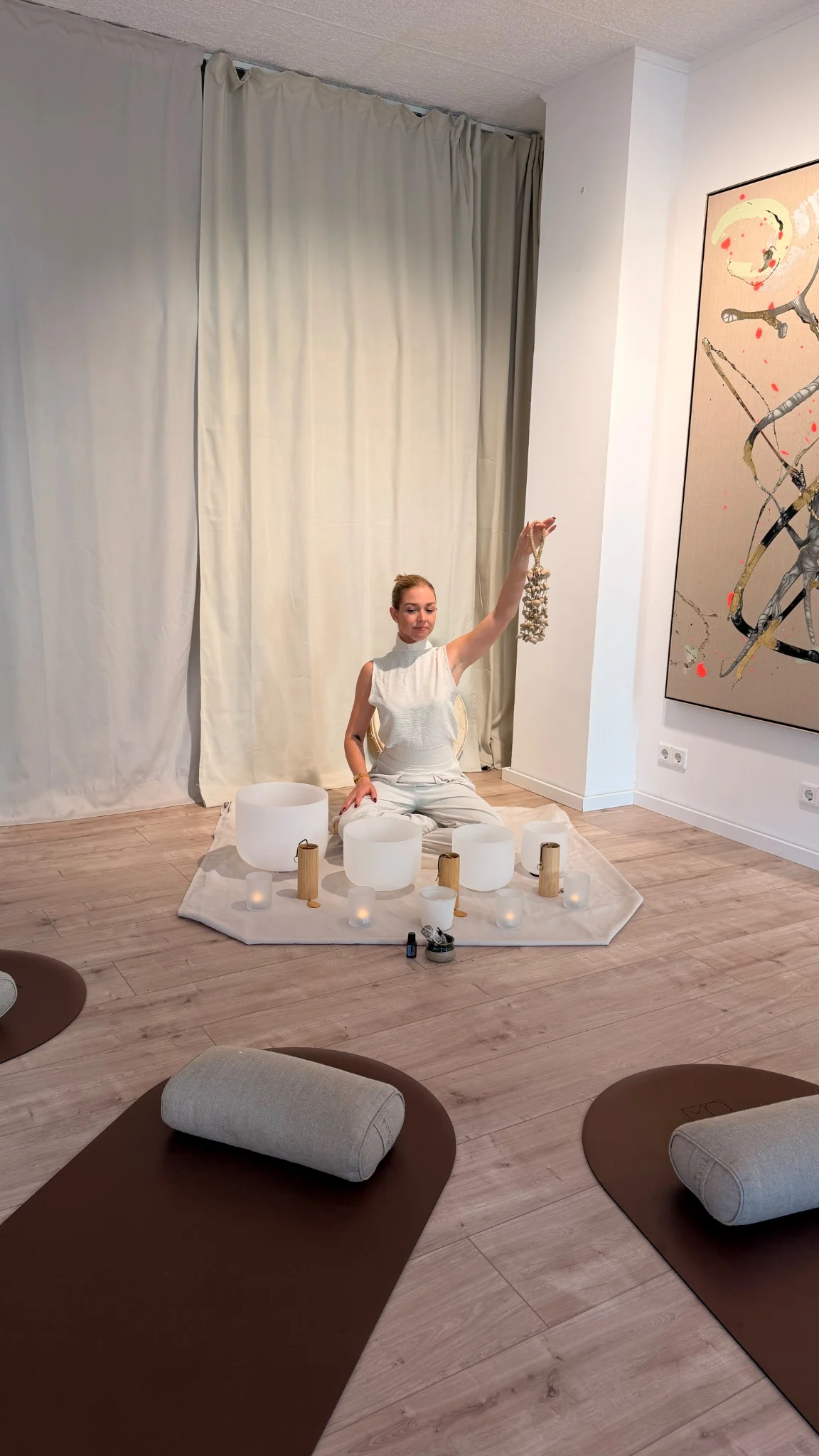
In my sessions, I bring guided meditation together with live crystal singing bowls. When I talk about frequency work, I mean a conscious practice with audible sound. I am interested in how you perceive it and what you discover for yourself.
What has been studied in sound meditation so far
A study from September 2026 followed adults practising daily sound meditation for four weeks. Afterwards, the intervention group had lower measures of anxiety symptoms and cortisol, among other findings, than the comparison group. However, the programmes also differed in location and delivery. The intervention used several instruments and audio recordings. Which element contributed to the results remains unclear. [1]
A smaller experiment from January 2026 examined just one minute of recorded singing bowl sound. Afterwards, people in this group rated their arousal lower than before. Their positive and negative emotional states did not change clearly. This points to an immediate listening experience; it tells us little about longer-term effects. [2]
You can experience sound and still want to understand what lies behind it.
Why the type of session matters
Two reviews from 2025 describe possible benefits of singing bowl interventions, including for anxiety or sleep. They also show how much the studies vary in their participants, instruments and research quality. Better-controlled studies are still needed. [3] [4]
Research on metal singing bowls does not automatically establish an effect for crystal singing bowls. Listening to a recording through headphones is also a different setting from a live instrument in the room. These differences matter when relating findings to a particular session.

What are 432 and 528 Hz about?
Hertz describes the number of vibrations per second. In music, you may often encounter 432 and 528 Hz described as special frequencies. A number alone, however, tells us nothing about a health benefit.
A study from April 2026 compared music carrying these labels with a group that listened to no music. After 20 minutes, there were differences in individual saliva markers, but no statistically established differences in the cognitive performance tested. There was no comparison with the same music at a conventional reference tuning. [5]
This does not establish a special healing effect of 432 or 528 Hz. The comparison cannot tell us whether any differences were due to frequency, music in general or other features.
What you can expect with me
I prepare a place for you, explain the flow and guide you with my voice. You also hear crystal singing bowls played live in the room. You can listen, rest and notice for yourself how you experience the time.
You do not need previous experience or a particular expectation. Perhaps you find a sound pleasant; perhaps it feels unfamiliar at first. You can change position and take a break whenever you need one.
I describe the flow in more detail in What to expect at a sound bath. If you have questions beforehand, you are welcome to contact me personally.
Further reading
Sources for this article
- Ravikumar & Sathyanarayanan (2026): Effects of a Sound-Based Meditative Intervention on Anxiety, Depression, Salivary Cortisol Levels, and Blood Pressure. Cureus, 2 September 2026. 100 adults; four weeks. Multiple components and different settings limit the attribution of effects.
- Starcke, von Georgi & Wersuhn (2026): A one-minute singing bowl intervention reduces subjective arousal compared with binaural beats, pink noise, and silence. Music and Medicine, 31 January 2026. 92 participants; online experiment. Short-term self-report; no long-term effects studied.
- Cai et al. (2025): Therapeutic effects of singing bowls: A systematic review of clinical studies. Integrative Medicine Research. 19 clinical studies, including nine RCTs. Heterogeneity and risk of bias limit the conclusions.
- Lin, Yang & Wang (2025): Effects of Tibetan Singing Bowl Intervention on Psychological and Physiological Health in Adults. Healthcare, 14 August 2025. 14 quantitative studies; no meta-analysis because the data were limited and heterogeneous.
- Bozok et al. (2026): Acute Music-Frequency Exposure Modulates Salivary Stress and Neurotrophic Markers in Young Adults. Brain and Behavior, online 27 April 2026. 162 students; saliva markers and Stroop test. No statistically established differences in cognitive performance.
Editorial and research information as of 28 October 2026. A selection of relevant academic publications, not a complete systematic review. The studies investigate different programmes and groups of people; they do not demonstrate the effectiveness of my own sessions.